Why a Coastal Boundary Never Feels Like Just a Line
A coastal boundary can feel more prominent than a field marking. Learn how to read its relationship with the shoreline, playing space and spectator view.
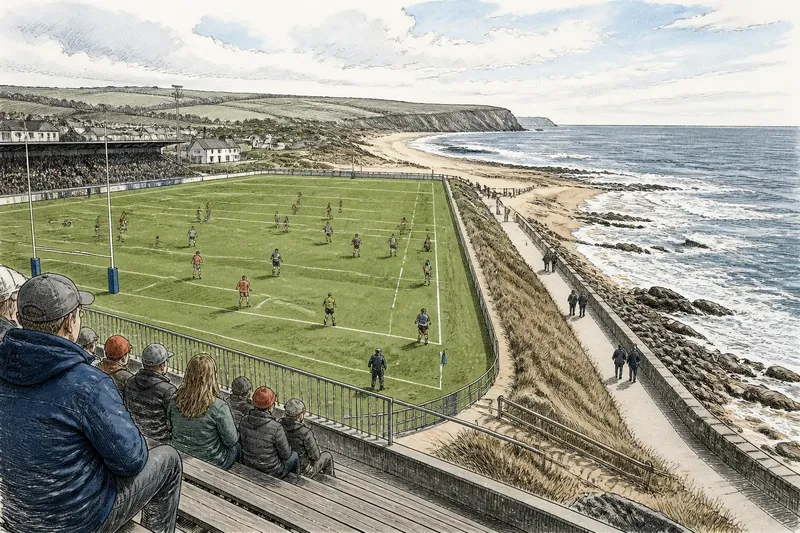
A coastal boundary can feel more prominent than a field marking because it sits between the game and a changing edge of land and water. From the stands, the same line may frame a player’s movement, divide the playing surface from the shore, or appear to pull the whole game toward the horizon. Reading those relationships makes it easier to understand why one boundary commands attention while another fades from view.
The useful question is not simply how close the sea is. It is how the boundary, the playable area and the spectator’s sightline meet. A viewer can read that meeting in several ways: as a visual frame, as a spatial edge or as a point where attention gathers. Each approach suits a different kind of venue and a different way of watching.
Boundary as frame
In some grounds, a boundary works like the edge of a picture. The playing space occupies the foreground, and beyond it the shoreline supplies a second, more distant line. When the two edges run in roughly the same direction, the eye can follow them together. The sports boundary then seems to organize the coast, even though it marks only the limit of play.
This reading suits a spectator who enjoys the overall shape of a match: where the teams are positioned, how the open side of the field changes the sense of space, and how movement travels across the ground. It is especially legible when a stand offers an oblique view, so the near and far boundaries do not collapse into one flat stripe.
To read the frame, compare three visible lines: the playing boundary, the land’s edge and the horizon. Ask which one your eye reaches first, and whether the lines seem parallel, converging or sharply divided. A fence, seawall, dune or strip of grass may add another line. Rather than treating those objects as background, notice whether they reinforce the field’s edge or interrupt it.
Imagine you are seated above a rectangular ground where the far boundary points toward a beach access path. As play shifts toward that end, the boundary may seem to lead the eye out of the field and toward the coast. If the same path crosses behind the goal at an angle, the visual effect changes: the boundary becomes a frame that contains the game, while the path pulls attention sideways.
Boundary as spatial edge
A second approach is to read the line as a change in space. On one side is the area players can use; on the other may be sand, rock, a promenade or a steep bank. The difference in surface and level can make the boundary feel heavier than a painted mark. Even without a dramatic view of the water, the ground beyond the line can give it a strong physical presence.
This approach suits viewers who pay attention to the usable shape of the venue. Look for where the playing surface narrows, where a barrier stands close to the line, or where the ground beyond it rises or drops. A boundary beside an open, level apron can feel like a gentle transition. The same line beside a retaining wall can read as a hard stop.
Material matters because it gives the eye clues about what lies beyond play. Pale sand beside dark turf creates a clear contrast. A concrete edge may appear continuous with a seawall, while a low grassy bank can soften the transition. These cues do not alter the official boundary, but they change how sharply a spectator perceives it.
There is a useful distinction between a line that marks an area and an edge that seems to resist movement. A spectator may instinctively follow a player’s run to the boundary and then notice the barrier, slope or loose surface beyond it. That sequence makes the line feel consequential: it is not only where play ends, but where the character of the ground changes.
Boundary as attention point
A third reading focuses on attention rather than layout. A coastal boundary can become a visual anchor because it sits where several competing features meet: players, spectators, structures and open water. The eye returns to it even when the ball is elsewhere. This is more likely when the line is unusually exposed or when a feature beyond it creates a strong contrast.
This approach suits a spectator who wants to understand how a venue directs the crowd’s gaze. Notice whether the boundary is easy to see from the stand, whether a barrier or row of posts repeats its direction, and whether the shoreline appears behind it or to one side. If the line is partly hidden by people or structures, the sea may still make the boundary’s location feel present by supplying a clear visual edge nearby.
Sound and movement can also draw attention toward the coast, but they do not replace the visual relationship. A flag, passing figure or breaking wave may attract the eye briefly. The boundary feels prominent when the view repeatedly connects such movement to the edge of play, rather than when the shoreline is simply visible somewhere in the distance.
Which reading fits?
These approaches are not competing explanations with one universal winner. They describe different things a spectator can observe. The frame approach is about lines and composition; the spatial-edge approach is about surfaces and transitions; the attention approach is about where the view keeps returning. Choose based on what makes the boundary noticeable from your seat.
- Choose the frame reading if you can see the field and shoreline together and want to follow how the venue’s geometry shapes the scene.
- Choose the spatial-edge reading if changes in surface, slope or barriers make the limit of play feel especially tangible.
- Choose the attention reading if your gaze keeps returning to the same stretch of boundary, even when the action moves elsewhere.
One quick way to decide is to trace your first glance and your second. If you notice the relationship between long lines, begin with the frame. If you notice what the ground changes into, begin with the spatial edge. If you keep looking back to a particular spot, consider attention. The first cue is not a verdict; it is a practical entry point for reading the venue.
Questions from the stands?
Why does the boundary seem closer to the sea?
A boundary may align with the shoreline or point toward an open coastal view, making the two edges appear connected. Perspective can also compress the apparent space between them, especially from a stand looking along the ground.
Does the shoreline have to touch the field?
No. A beach, seawall or visible water beyond the venue can shape the boundary’s appearance without meeting the playing surface. The important feature is the spectator’s view of how the field’s edge relates to the coast.
Why can a small barrier make the line feel stronger?
A fence, rail or wall repeats the boundary’s direction and gives the eye a solid form beside the playing area. That added structure can make a painted or marked line feel more definite, even if the barrier sits beyond it.
Can the same boundary look different from another seat?
Yes. A seat closer to the end of the ground may make lines converge, while a side-on view can show their separation more clearly. A changed sightline can shift the boundary from frame to foreground edge or attention point.
A better seat-side reading
For a fuller reading, look once at the playing surface and once beyond it. Identify the boundary without following the ball, then notice the nearest coastal feature and the line of the horizon. Finally, see whether your eye connects them or keeps them separate. This small pause can reveal whether the line feels prominent because it frames the view, marks a physical transition or gathers attention.
The coastal boundary is not made more important by the sea alone. Its force comes from the relationship a spectator can see: a field line beside a changing surface, set against a shoreline that may echo it, cross it or pull the view away. Next time you watch a coastal game, use that relationship as your guide. The boundary will tell you not only where play ends, but how the venue asks you to look.